Before the first lockdown in 2020, I was working on pieces for an HB Drawing group show Found In Translation, to be held in April 2020 at No Format Gallery in Deptford, London SE14. After its inevitable cancellation, we decided to make an online show instead. The original proposal for the show worked just as well:
What are we doing when we ‘draw from drawings’? The artists of HB Drawing have been using regular sessions in the British Museum Prints and Drawings Department Study Room to explore this.
Historically, copying was seen as the foundation of learning to draw and to become an artist. … This approach was rejected by modernists who privileged expression and originality over skill. … Contemporary art education curricula hover between these positions …
The Bridget Riley Art Foundation (BRAF) has funded the programme at the British Museum which made possible our initial experience of drawing from the Museum’s collection. This programme reflects Riley’s own belief that we can look at older artists’ work
‘not just as historical events in the past but as a basis for the present, one can discover points of departure …’
Sarah Jaffray, project officer and lead educator for the BRAF programme at the Museum, suggests that the language of translation, rather than transcription, better describes the potential for transformation involved when drawing from another artist’s drawings. Translation from one language to another aims not just at equivalence but ‘the production of a response comparable to the one produced by the foreign text in its own culture.’ …
HB Drawing proposes an exhibition that starts from the historic legacy of drawing to create work that responds to the current context, bringing the past into the present. …
There are many ways of doing this. I am exploring my response to the British Museum project in drawing and in felt, which you can see on a separate page.


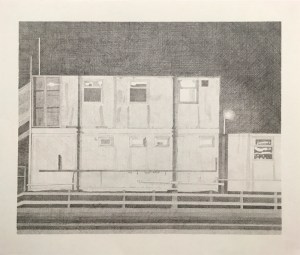
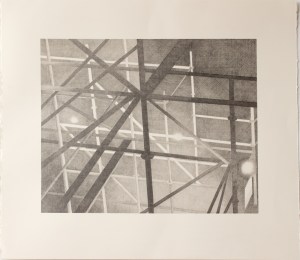
These drawings explore a technique adapted from the one used by Keith Coventry in his etching Crack Pipes 2, 2006. What interested me was the overall use of line to create tone and the application of this technique to a mundane, indeed abject subject: pipes for crack addicts which appear to be made from plastic water bottles with spouts. My attention shifted back and forth between the overall image of this controversial subject and the painstaking way they were depicted so that they emerged into the light.
That’s what I aimed at in this series: a drawing of mundane, abject objects like portakabins and scaffolding poles – emerging out of the darkness of the night, out of a tangle of lines. I find them quite mysterious.
Please click on an image to expand the gallery.
 Su Bonfanti